Posts

Heroic Beings

Image
I want to share about a Buddhist text I studied in RYI that has been extremely helpful for me to embark on the Buddhist studies. This text is The Way of The Bodhisattva. Since it is in verse, it was easier to study with a commentary. First of all, a Bodhisattva is a being who possesses bodhichitta, which is the mind that wishes to obtain enlightenment for the benefit of all sentient beings. This definition shows the main characteristic that a Buddhist (in the Mahayana tradition) must possess. In the broad view, Buddhas teach the dharma, the path  towards cessation of suffering. Meanwhile, they also help and protect sentient beings from immediate sufferings such as deprivations for survival and fear from the adversaries, through their generosity. The intention behind this, which is bodhichitta, is solely to relieve the beings from suffering in this life and future lives. That is the reason why bodhisattvas are called sometimes heroic beings. Heroic is their practice and supre...

A Place for Inspiration

Image
“The happiest man is he who learns from nature the lesson of worship” ― Ralph Waldo Emerson Often, when a person settles in a location, one eventually becomes accustomed to his or her surroundings and can easily become complacent. I am grateful to reflect that, after almost three years living in Nepal, I still carry the same sense of awe that I had when I first arrived. On more than one occasion, I have walked down any road in Boudha with a friend or a colleague and wondered how strange and incredible it is that I (or we) landed here. This sense of awe is especially apparent when I walk with somebody who has never seen Boudha or Nepal before, for through fresh eyes can we revitalize our experience of the world. Life in Nepal provides a number of opportunities for students, but the most promising of those opportunities are the people we meet and the places we go to find inspiration. At RYI, we have a supportive community, and have the opportunity to work closely with...

Reading Week

Image
Once every semester we get a week off, the so-called reading week. As the name suggests, I spent my reading week this semester reading academic literature and preparing for my classes in advance, as well as studying vigorously for my upcoming exams. Right? Well, wrong. Rather, I like to take my reading weeks as nature weeks – finally having the time to explore this beautiful country, because let’s be honest, apart from all the adventures it has to offer,  Kathmandu is probably the least physically attractive place of the entire country of Nepal. This time, I ended up going for a trek in the Langtang valley, which had been recommended to me multiple times by several people. Langtang valley was greatly affected by the 2015 earthquake, but since a couple of years tourism there is starting to thrive again. Yet in some villages on the trek, the shock and the trauma is still almost physically tangible. And every single local person we got to talk to during our trek had a person in...

Introducing Pāli and Buddhist Literary Chinese

Image
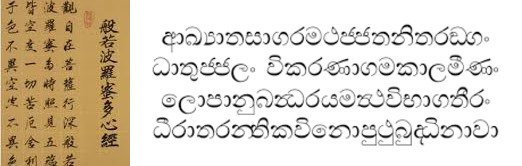
Since RYI will conduct P ā li and Buddhist Literary Chinese in the coming Summer Program, I am happy to introduce these languages here, which I have studied before. In my opinion, the most difficult language to study is Chinese since there is no alphabet in Chinese characters. In other words, to read Chinese, we need to memorize each distinct character. From grammatical aspects, nouns and adjectives which do not inflect for case, definiteness, gender make Chinese is more challenging and difficult to comprehend. Moreover, verbs do not inflect for person, number, tense, aspect, or voice. To study Buddhist literary Chinese, usually students are firstly guided from the basic Classical Chinese text, such as Sanzijing .   Pali and Sanskrit are very closely related and the common characteristics of both languages are easily recognized. In fact, a very large proportion of Pali and Sanskrit word-stems are identical in form, differing only in details of inflection. Pali nouns inflect...

Budhanilkantha Temple

Image
Budhanilkantha Temple lies on the northern side of Kathmandu valley, just below the Shivapuri hill. The temple is associated with the Hindu god, Bishnu. A Bishnu statue of about 3m height in a sleeping position is the main attraction for people. The statue is wholly made out of stone and depicts the god, Bishnu with his four arms sleeping on the serpent-couch. The origin of the temple is yet unknown and unclear. But a famous myth tells that the present day temple was actually a field owned by a old guy named Nilkantha. While plouging the field, the second finger of the right feet of the statue was cut and blood started seeping out. After digging deep, the statue was excavated. The name Budhanilkantha was kept in accordance to the guy who found the statue. The temple houses a gurukul where the students are taught Sanskrit. The daily aarati of the statue that takes place two times a day, in the morning and evening is done by the young student of the gurukul. It seems th...

A Place Where the Dharma Feels Alive

Image
I took this photo when I finished school one day, chancing upon the monks who had just finished their evening Puja. Their yellow robes were rather conspicuous against the white walls and marble ground. This reminds me of some words said by previous masters in those commentaries, that one should respect even tiny piece s of red or yellow cloth , as they are representations  of the auspicious Three Jewels. In this so-called " time of degeneration " , we are still able to study full-time the dharma, the scientific method that brings mundane and super-mundane benefits to both ourselves and others, and get to call ourselves practitioners , I guess for this , or for this scene alone , I am already grateful. This is my first time in this country. As a first-year BA student at Rangjung Yeshe Institute, my focus here is on the Tibetan language and Buddhist philosophy. The language course here is very intensive: B efore I came here, I’ve finished the alphabet and pronun...

Halfway Through the Translator Training Program (TTP)

Image
Halfway Through the Translator Training Program (TTP) This is my most happy and joyful year at RYI. Three years since starting with the Bachelor Program (BA) I adventured myself into the Translator Training Program (TTP) – a one-year course that trains students to orally interpret from Tibetan into English. The TTP includes: Ø   One course of your choice during the two-month Summer Program. Ø   The Fall Semester and the Spring Semester, where you have classes five days a week from 8am to 4pm. Ø   Six weeks of Translation Seminar (exclusive for TTP students): two weeks during the winter break and four-weeks after the end of the Spring Semester. During the Summer Program I enrolled into the Adv anced Colloquial Tibetan, a course that radically enhanced my capacity to both speak and understand the language. [1] The course was a great support to boost my Tibetan and be comfortable to start the first day of the Fall Semester, where the actual training in interp...